When a child encounters the word unbreakable for the first time, one child sounds it out syllable by syllable and reads it aloud. Good decoding. But does she know what it means?
Another child sees something different. She sees three meaningful parts:
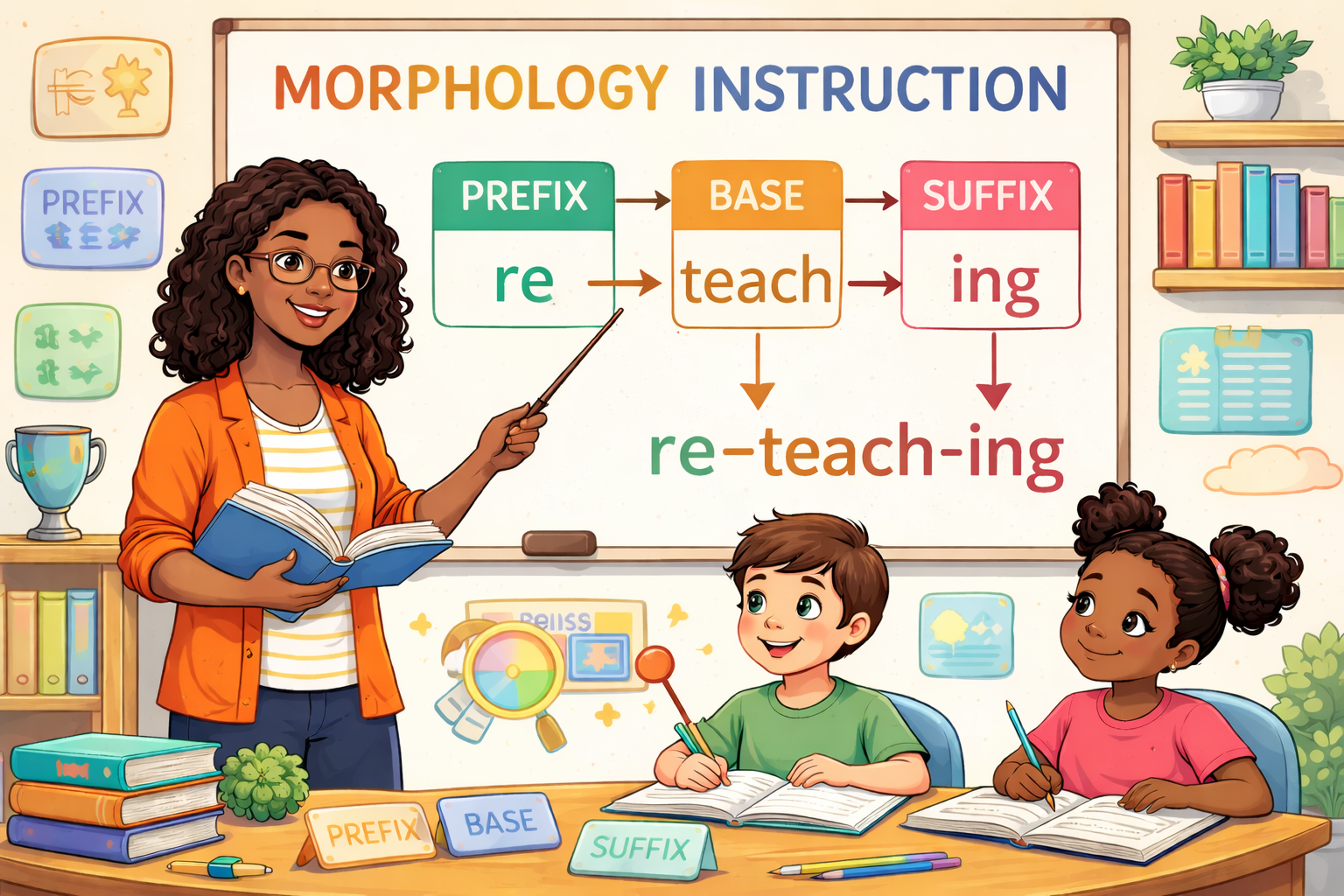
un- (not) + break (core meaning) + -able (can be done)
Three morphemes, each one meaningful. She doesn’t just read the word. She understands it: “not able to be broken.”
That child is using morphological awareness, one of the most powerful yet overlooked tools in a young reader’s toolkit. Syllabication is where decoding starts. But as students grow, the way they break words apart needs to evolve.
What Is Morphological Awareness?
Morphological awareness is the ability to recognize that words are made up of smaller meaningful units called morphemes: prefixes, suffixes, and base words. It’s not about hearing syllables or sounding out letter patterns. It’s about meaning.
Research consistently shows that morphological awareness predicts reading comprehension, vocabulary knowledge, and spelling ability. By age ten, a child’s knowledge of word structure is actually a better predictor of decoding than phonological awareness alone (Mann & Singson, 2003). Morphological awareness bridges decoding and meaning simultaneously.
Why We Say “Base Words,” Not “Roots”
You may have heard these terms used interchangeably, but they mean different things.
A base is the core element of a word that carries its primary meaning. Bases come in two types:
Free base: Canstand alone as a complete English word.
play in replaying · break in unbreakable
Bound base: Cannot stand alone. Needs an affix to form a word.
struct in construction · rupt in disruptive
A root refers to the historical origin of a word part in Latin, Greek, or another source language. That’s valuable etymological knowledge, but in the classroom, students need to recognize struct as a base that carries meaning across a whole family of English words:
struct → structure · construct · instruct · destructive · restructure
When we use “base word” with students, we keep the focus on English and on what’simmediately useful. That’s the approach ROYO takes.
The Shift From Syllables to Meaning
In the early stages of reading, syllabication is essential. We teach children to break multisyllabic words into chunks so they can sound out unfamiliar words one piece at a time. ROYO supports this through our systematic, Science of Reading-aligned scope and sequence.
But syllabication is about pronunciation. Morphology is about meaning. As readers develop, their approach to longer words should evolve from one to the other.
Consider the word interrupting. Notice how the two approaches divide it differently:
Syllables: in· ter · rupt · ing
Four chunks to pronounce.
Morphemes: inter- + rupt + -ing
Three parts with meaning.
inter- means“between” · rupt means “to break” · -ing signals ongoing action
Syllabication splits inter- into in and ter, hiding the prefix entirely. A morphological approach keeps it intact, and the meaning comes through: to interrupt is to “break between.”
Research shows that roughly 60% of new words students encounter in text are made up of familiar morphemes that can guide them to meaning (Nagy & Anderson, 1984). A student who knows a handful of common prefixes, suffixes, and bases has astrategy for unlocking thousands of unfamiliar words on their own.
How ROYO Brings Morphology to Life
ROYO’s personalized, decodable stories meet each student where they are. As students progress through our scope and sequence, they move naturally from foundational phonics into morphologically rich territory.
Before students begin reading their story, ROYO’s pre-read activities buildmorphological awareness, drawing attention to the meaningful parts within the words they’re about to encounter. By the time they start reading, they’ve already begun thinking about how those words are built and what they mean. Then, as they read stories they’re excited about because they star in them, they reinforce those connections in context.
From Decoding to Deep Understanding
Morphological awareness gives students a strategy that grows with them, from un- + break in second grade to inter- + rupt in upper elementary to bio + logy in middle school and beyond. At ROYO, we support every stage of that journey, starting with the phonics foundation every reader needs and building toward the morphological awareness that unlocks vocabulary, deepens comprehension, and fosters a love of reading.
Because when a child looks at an unfamiliar word and sees not just letters to decode but meaning to discover, that’s when reading truly becomes their own.