Every teacher has felt the gap between a student who reads without being asked twice, and one who needs to be bribed into reading at all. We've spent a lot of time thinking about that gap and what actually gets a student to want to read.
The usual answer is choice. Let a student pick a topic they like, and a reluctant reader often comes alive. But we've been sitting with a subtler question: what happens when a student isn't just choosing a topic, but choosing who they get to be in the story?
Picture a story where a student isn't reading about an astronaut, but reading about themselves, by name, as the astronaut. Or the scientist. Or whatever they can imagine. That's a small shift on paper, but it points at something bigger.
Researchers have a name for part of what's going on here. In the 1980s, the idea of “possible selves” was introduced — the notion that we're motivated not only by who we are right now, but by who we imagine we could become. Later researchers built on that idea considerably, including a finding we keep coming back to: the more possible selves a person can vividly imagine, the more motivating and directive those images tend to be.
Professor Ronald Ferguson at the Harvard Kennedy School coined the term “future possible selves”. That's not just a framework about reading confidence, but also a framework about identity and how many futures a kid can picture for themselves, and how real those futures feel.
Which made us wonder: what if reading practice could be one of the places kids first explore those futures? Through a story where they're actually the astronaut, actually the scientist, actually the one solving the problem.
We don't think this happens through choice of topic alone. There's a difference between a student picking a book about an astronaut, and a student becoming the astronaut inside their own story. The first is interest. The second is identity.
It also reframed a distinction we hadn't thought carefully about before: the difference between customized reading practice and personalized reading practice.
Customized decodables are built around a student's curriculum and reading level matched to the right skills, at the right difficulty.
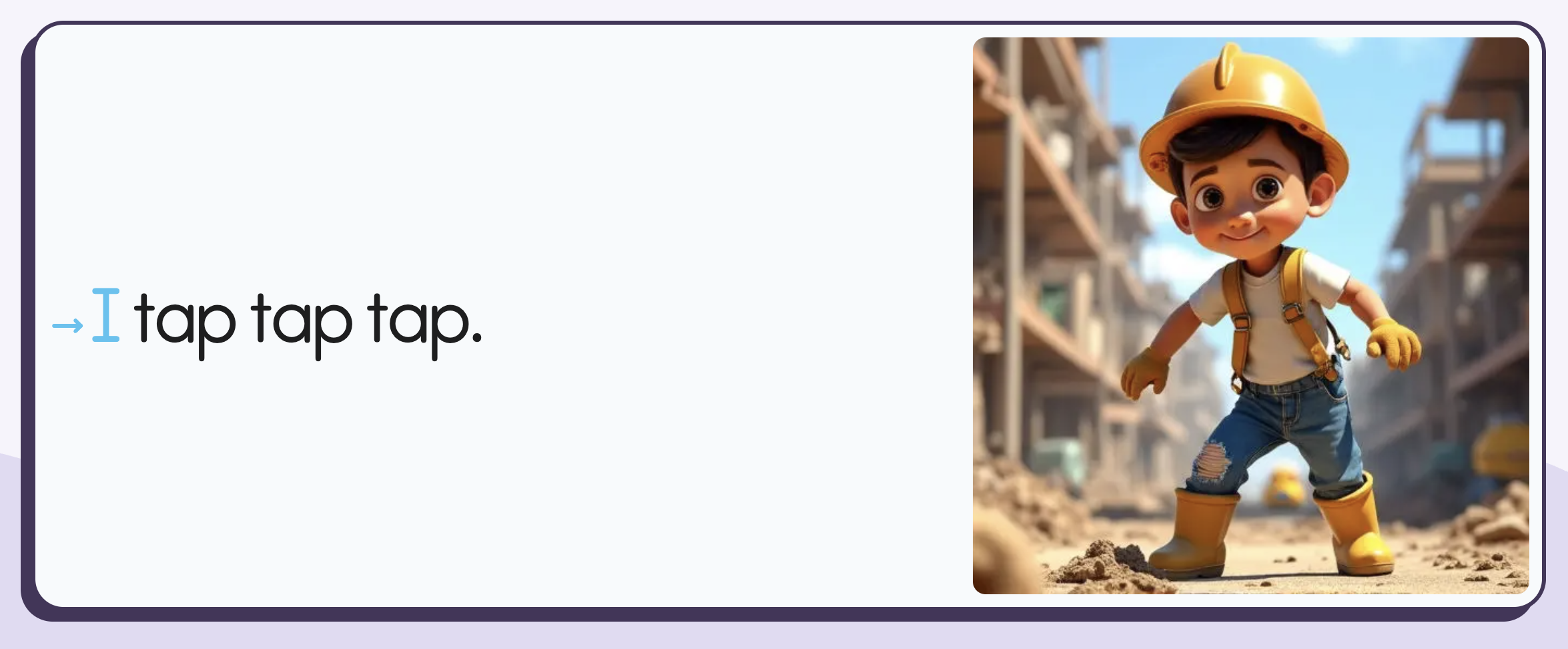
Personalized decodables start from that same foundation, but go further: the student becomes the protagonist, by name, and gets to choose what they are within the story: an astronaut this week, a scientist the next. The curriculum and reading level are still there, doing their job underneath. But the story itself becomes a small, repeated chance to imagine a future self.
In practice, the difference we notice first isn't philosophical, it's behavioral. A student asking what happens next. A student finishing a book because they want to know how their own story ends, not because it was assigned. A student reaching for a book during free time instead of being reminded to. Those are small moments, but they're the actual target. Everything else is in service of getting there.
We don't know exactly how much of that is the identity piece versus the choice piece versus just good stories since reading motivation is more complicated than any single framework can capture. But there's an idea we find ourselves returning to: the earlier and more often a child gets to picture different versions of who they could become, the more reasons they seem to find to keep reading one more chapter, one more book, one more story where they're the one who solves it.
That's the question shaping ROYO's personalized stories: not just what a student wants to read about, but who they get to become while they're reading it. The same story ends up doing two jobs at once: reading practice, and something that makes a student want to pick a book back up tomorrow.